
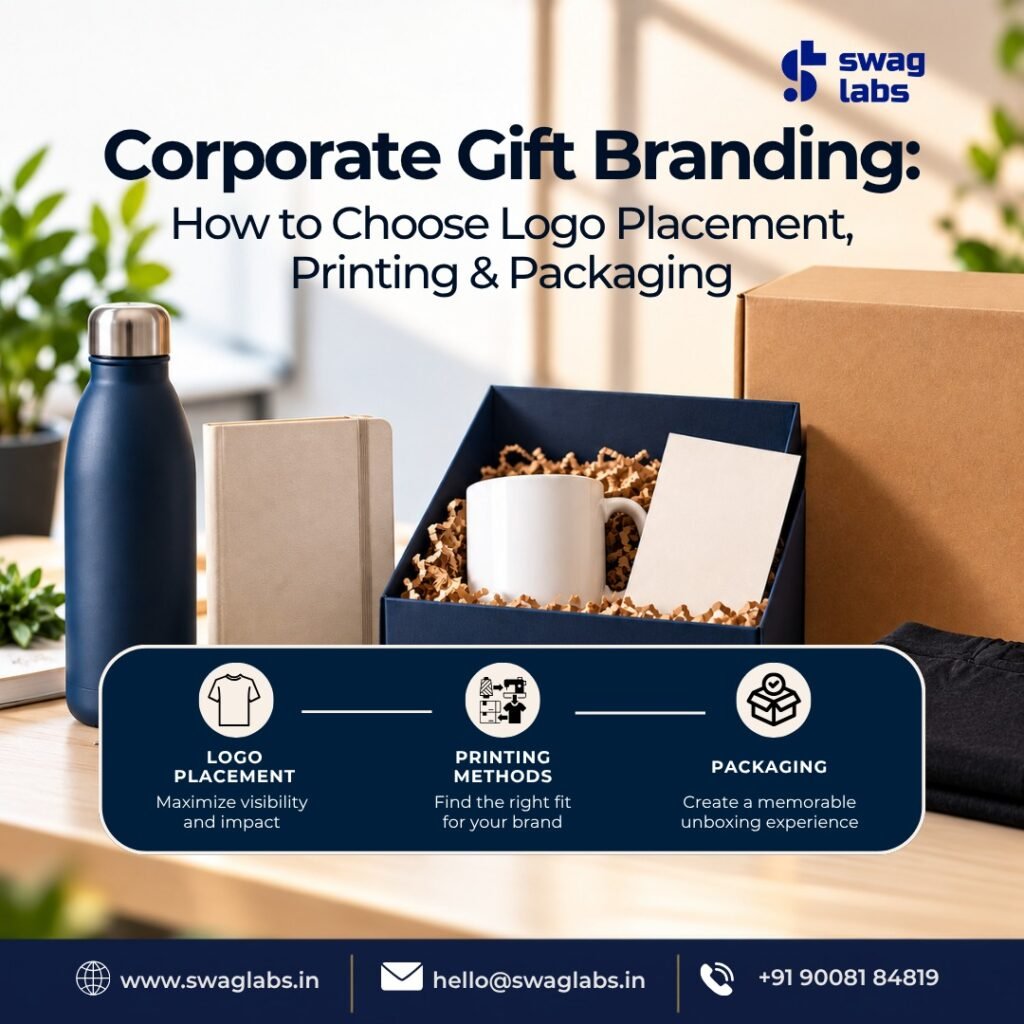
Corporate Gift Branding: How to Choose Logo Placement, Printing & Packaging
Corporate gift branding is not just about adding a logo to a product. The final result depends on the product surface, branding method, logo size, placement, and packaging. A well-branded bottle, T-shirt, diary, or backpack should look like a natural part of the company’s brand, not a promotional item with an oversized logo.
Yes. Most common corporate merchandise can be branded with a company logo, but the best method depends on the product material, surface, artwork, quantity, and finish you want.
For example, a fabric T-shirt may suit embroidery or DTF, while a metal bottle can work well with laser engraving. A detailed colour logo may need a digital printing method, while a leather or PU diary can suit embossing.
SwagLabs currently offers embroidery, screen printing, DTF, UV printing, embossing and engraving for different types of merchandise. Its own printing guidance also notes that the artwork requirements vary by method.
That means the right question is not simply, “Can you print my logo?”
It is:
What Products Work Best for Branded Corporate Gifts?
The product should come first. Branding works better when the item has a suitable print area, the right surface, and a clear reason for the recipient to use it.
For branded corporate gifts, these are practical options:
T-Shirts
Best for employee merchandise, events, and team campaigns.
Common choices include:
- Embroidery for polos and premium apparel
- Screen printing for simple solid-colour logos
- DTF for detailed graphic artwork
SwagLabs specifically lists embroidery, screen printing, and DTF for T-shirts, sweatshirts, bags, caps, and jackets.
Bottles
Bottles give you a clean, visible branding area and are useful for employee and event merchandise.
For a metal bottle, laser engraving is often chosen when the goal is a permanent, understated mark. For other surfaces, a suitable print method may be more appropriate. The material matters more than the product name alone.
Bags and Backpacks
Bags can support larger visible branding, especially when the front panel is easy to access.
Embroidery works particularly well on fabric bags and jackets, while screen printing may be suitable when you want a larger flat logo at volume.
Diaries and Notebooks
These are useful for more subtle company-branded gifts.
A small logo on the cover can look cleaner than a large graphic. Depending on the cover material, printing or embossing can create very different finishes.
Mugs
Mugs can support printed logos, but the surface shape matters. A logo that looks good on a flat artwork file may need adjustment before it is placed around a curved mug.
Tech Products
Speakers, chargers, power banks and other hard-surface products may use UV printing or engraving depending on the material and shape. Detailed, full-colour artwork can require a different approach from a simple one-colour logo.
Gift Boxes
The box itself can carry the brand through printing, sleeves, stickers, inserts or other packaging treatments. This is useful when the product branding needs to remain subtle
Logo Placement on Corporate Gifts: Where Should It Go?
Logo placement on corporate gifts should be based on visibility, balance and the shape of the item.
| Product | Recommended placement |
|---|---|
| T-shirt | Chest/sleeve |
| Bottle | Front body |
| Diary | Cover |
| Backpack | Front panel |
| Mug | Main visible side |
| Tech product | Flat visible area |
Keep the logo proportional
A small logo can look premium on a bottle or diary. The same artwork may feel oversized on a pen or small accessory.
Before production, check:
- Logo width and height
- Clear space around the mark
- Distance from product edges
- Placement against the product colour
- Whether the logo stays readable at the actual size
Think about how the product is held
A logo should not disappear when the item is being used.
For example:
- A bottle logo should remain visible when the bottle is standing normally.
- A backpack logo should sit on a panel that is not constantly folded.
- A T-shirt logo should be positioned where the garment will not distort it excessively.
This is where corporate gift branding becomes a design decision rather than a simple printing task.
Corporate Tech Gifts by Budget
Budget should influence the product, not eliminate usefulness.
A common mistake is trying to make a small budget look premium by adding too many cheap products. A better strategy is usually to select fewer items with better perceived and practical value.
Affordable Corporate Tech Gifts
For tighter budgets, consider:
- Cable organizers
- USB accessories
- Phone stands
- Compact desk gadgets
- Simple branded charging accessories
- Entry-level wireless accessories
This segment works well for larger employee counts, conferences, seminars, and promotional events.
The key is consistency. A simple product with clean packaging and professional branding often looks better than five unrelated low-cost gadgets.
Mid-Range Options
A mid-range budget gives you more room to choose products employees will genuinely keep.
Good options include:
- Wireless chargers
- Better-quality power banks
- Wireless mice
- Bluetooth speakers
- Useful desk kits
- Laptop accessories
- Compact tech gift sets
This is often the sweet spot for employee recognition, onboarding, and annual gifting because the products can feel meaningful without becoming excessively expensive.
Premium Corporate Tech Gifts
Premium budgets can support more complete gifting experiences.
Options may include:
- Premium headphones
- Higher-end speakers
- Premium power banks
- Multi-device charging stations
- Curated technology gift boxes
- Tech-focused executive hampers
- Combined work-and-travel kits
Premium does not have to mean extravagant.
A well-selected three-item kit can feel more valuable than a large box filled with unrelated products.
Corporate Gift Printing Methods: Which One Should You Choose?
There is no single “best” method for every product. The surface and artwork should determine the process.
1. Screen Printing
Best for: T-shirts, bags and simple solid-colour artwork
Screen printing is useful when you have a relatively simple logo and a bulk quantity. It can produce a strong, clear mark, especially on suitable fabrics and flat surfaces. It is generally more practical for designs with solid colours than highly detailed gradients.
Choose it when:
- Your logo uses simple colours
- You need bulk production
- The product has a suitable printable surface
Watch out for: Very fine detail and complex colour transitions.
2. Embroidery
Best for: T-shirts, polos, jackets, bags and fabric products
Embroidery stitches the artwork into the fabric rather than applying ink on top. It can create a premium, tactile finish.
SwagLabs notes that embroidery works on T-shirts, bags, caps, and jackets, but gradients, textures, and overlapping graphic colours are not suitable for the technique.
Choose it when:
- The logo is relatively simple
- You want a stitched premium appearance
- The product is fabric-based
Watch out for: Tiny text and very detailed artwork.
3. DTF Printing
Best for: Detailed fabric artwork
Direct-to-film printing is useful when the artwork has more visual detail than a simple screen print can comfortably handle. SwagLabs describes DTF as a heat-transfer method for fabrics such as T-shirts, sweatshirts, bags, caps, and jackets.
Choose it when:
- You have detailed artwork
- You need several colours
- The product is fabric
Watch out for: The final look depends on the garment and artwork quality.
4. UV Printing
Best for: Hard surfaces and detailed colour artwork
UV printing uses UV light to cure ink on the surface. It can be useful for products such as tech accessories, acrylic, aluminium, and other hard surfaces. SwagLabs lists UV printing among its available branding methods.
Choose it when:
- You need detailed colour reproduction
- The product has a suitable hard surface
- You want a direct-print finish
Watch out for: Curved surfaces and unusual product geometry may require a different approach.
5. Laser Engraving
Best for: Metal, wood, and selected hard materials
Laser engraving creates a mark by removing or altering the surface material. It is often chosen for a clean, permanent, and understated finish. Corporate gifting suppliers commonly position engraving for metal, wood, and similar materials.
Choose it when:
- The product is metal or wood
- You prefer subtle branding
- You want a permanent-looking finish
Watch out for: It is not the right choice when your logo depends on full-colour reproduction.
6. Embossing and Debossing
Best for: Leather and PU covers
Embossing raises the design, while debossing presses it into the material. This gives diaries, folders and leather-look products a more tactile finish.
Choose it when:
- The product has a suitable leather or PU surface
- You want discreet branding
- A premium tactile effect matters more than colour
How Do I Choose Branding for a Logo?
For custom branded corporate gifts, use the logo and material together.
A simple decision guide:
Simple one-colour logo
→ Screen printing or embroidery
Metal product
→ Laser engraving
Detailed or full-colour artwork
→ UV printing or DTF where suitable
Leather or PU product
→ Embossing or debossing
The important point is that the logo should be prepared for the production method. A design that works perfectly on a website may need changes before it is printed, embroidered or engraved.
SwagLabs also specifies different file formats for different techniques, such as vector artwork for screen printing, UV printing, embossing and engraving, and high-resolution image files for DTF and embroidery.
Corporate Gifts and Branding: Product, Packaging or Both?
Good corporate gifts and branding do not always require a large logo on the product.
There are three approaches.
Product branding only
Best when the product itself will be used repeatedly.
Examples:
- Bottle with a small logo
- T-shirt with a chest mark
- Diary with a subtle cover logo
Packaging branding only
Useful when the gift itself should feel less promotional.
Examples:
- Branded box
- Printed sleeve
- Custom insert card
- Branded wrapping
Product + packaging
This can create the strongest unboxing experience, but it should be used with restraint.
A practical combination might be:
Small logo on bottle + branded gift box + personalised note
That can feel more considered than putting a huge logo on every surface.
Current search results also show strong emphasis on packaging as part of the overall corporate gifting experience, rather than treating packaging as an afterthought.
How Long Does Custom Corporate Gift Branding Usually Take?
There is no single turnaround time for every order.
The actual timeline depends on:
- Product availability
- Quantity
- Branding method
- Artwork approval
- Custom packaging
- Personalisation
- Delivery locations
- Production workload
That means you should not ask only, “How many days does printing take?”
Ask for the full order timeline:
Artwork approval → sample → production → packaging → dispatch → delivery
Some current corporate-gifting suppliers advertise sample and production windows such as around 7–15 working days, but those are supplier-specific and should not be treated as a universal industry promise.
Can I Mix and Match Different Gifts in a Corporate Order?
Yes, but the practical challenge is maintaining consistency.
For a mixed order, confirm:
- Same logo treatment
- Consistent brand colours
- Matching packaging
- Clear item quantities
- Individual names where required
- Final approval before production
For example, a company might choose:
T-shirt + bottle + diary + backpack
The branding method does not need to be identical across all four. In fact, it usually should not be.
A better approach is:
Embroidery on T-shirt → engraving on bottle → cover branding on diary → embroidery or print on backpack
That keeps the branding appropriate to each material.
Can I Get Sample Corporate Gifts Before Placing a Large Order?
For a large order, asking for a sample or production proof is a sensible quality-control step.
Check the sample for:
Logo
Is it the correct size?
Position
Is it centred or placed where approved?
Colour
Does it match the expected brand appearance?
Finish
Does the print, embroidery or engraving look clean?
Product
Is the actual product the same quality and colour that was quoted?
Packaging
Does the finished presentation match the approved concept?
Some suppliers currently promote digital mockups and pre-production samples as part of the corporate branding process.
For a large corporate order, a sample is cheaper than discovering a mistake after hundreds of units have been produced.
What Corporate Gifts Can I Personalize With Employee Names?
Individual personalization can work well for:
- Diaries
- Notebooks
- Bottles
- Bags
- T-shirts
- Welcome kits
- Gift boxes
But personalization adds another layer of quality control.
For a 300-person order, you may have:
300 names + 300 products + 300 addresses
That creates more opportunities for spelling, placement and fulfilment errors.
Before production, confirm:
Name list → spelling → product mapping → artwork → final approval
This is one reason a structured bulk-order process matters when using personalised business merchandise.
How Do I Know if a Corporate Gift Vendor Is Reliable?
Don’t judge a vendor only by a catalogue full of attractive products.
Ask practical questions.
Before ordering
Check whether the supplier can explain:
- Which branding method suits your product
- What artwork format they need
- Whether a sample is available
- How bulk quality is checked
- What happens if an item is damaged
- How they handle individual names
- How multi-location delivery is managed
- What is included in the quotation
A reliable supplier should be able to explain the process clearly rather than simply saying, “Yes, we can customise it.”
For company-branded gifts, the process matters almost as much as the product.
Corporate Gift Branding Sample Approval Checklist
Before approving bulk production, check these seven items:
| Check | What to verify |
|---|---|
| Logo | Correct artwork/version |
| Size | Approved dimensions |
| Placement | Exact position |
| Colour | Brand colour / approved appearance |
| Method | Correct print or branding method |
| Product | Correct item, colour and finish |
| Packaging | Approved box, insert and presentation |
Then confirm:
Final sample approved → production starts
Do not approve a large order from a product catalogue image alone when the branding treatment has not yet been tested.
Why Choose SwagLabs for Corporate Gift Branding?
SwagLabs already offers multiple branding methods through its Our Prints service, including embroidery, screen printing, DTF, UV printing, embossing and engraving. The company also explains which products each technique can be used on and what artwork files are required.
That gives buyers a useful starting point:
Choose the product → select the appropriate branding method → approve the artwork → confirm the sample → proceed with the bulk order.
For a larger project, the next step is to connect the branding choice with the actual merchandise requirement. SwagLabs can then move the project from product selection to customization and final delivery.
Planning Corporate Gift Branding for Your Company?
Logo placement + branding method + product material + packaging + personalization
✔ MOQ from 50 units • ✔ Pan-India Delivery • ✔ Free Design Support
Final Thoughts
Good corporate gift branding is not about putting the biggest possible logo on a product. It is about choosing a product people will use, selecting a branding method that suits its material, placing the logo where it looks natural, and checking the final sample before bulk production.
When those decisions are made together, branded corporate gifts can look professional without becoming overly promotional. That is the balance to aim for: useful products, clear brand recognition, and a finish that still feels like a gift.
Frequently Asked Questions:
Can I Add My Company Logo to Corporate Gifts?
How Long Does Custom Corporate Gift Branding Usually Take?
Can I Get a Sample Before Placing a Large Corporate Gift Order?
Can corporate tech gifts be branded with a company logo?
Can I Personalize Corporate Gifts With Employee Names?
Can I Mix Different Products in One Corporate Gift Order?
How Do I Know if a Corporate Gift Vendor Is Reliable?
Swaglabs, powered by Star Gifting Solutions, helps businesses across India create premium branded merchandise and corporate gifting solutions. From custom branding and packaging to storage and PAN India delivery, we manage the entire process for orders starting from 50 to 5,000+ units
Product Categories
Recommended Products
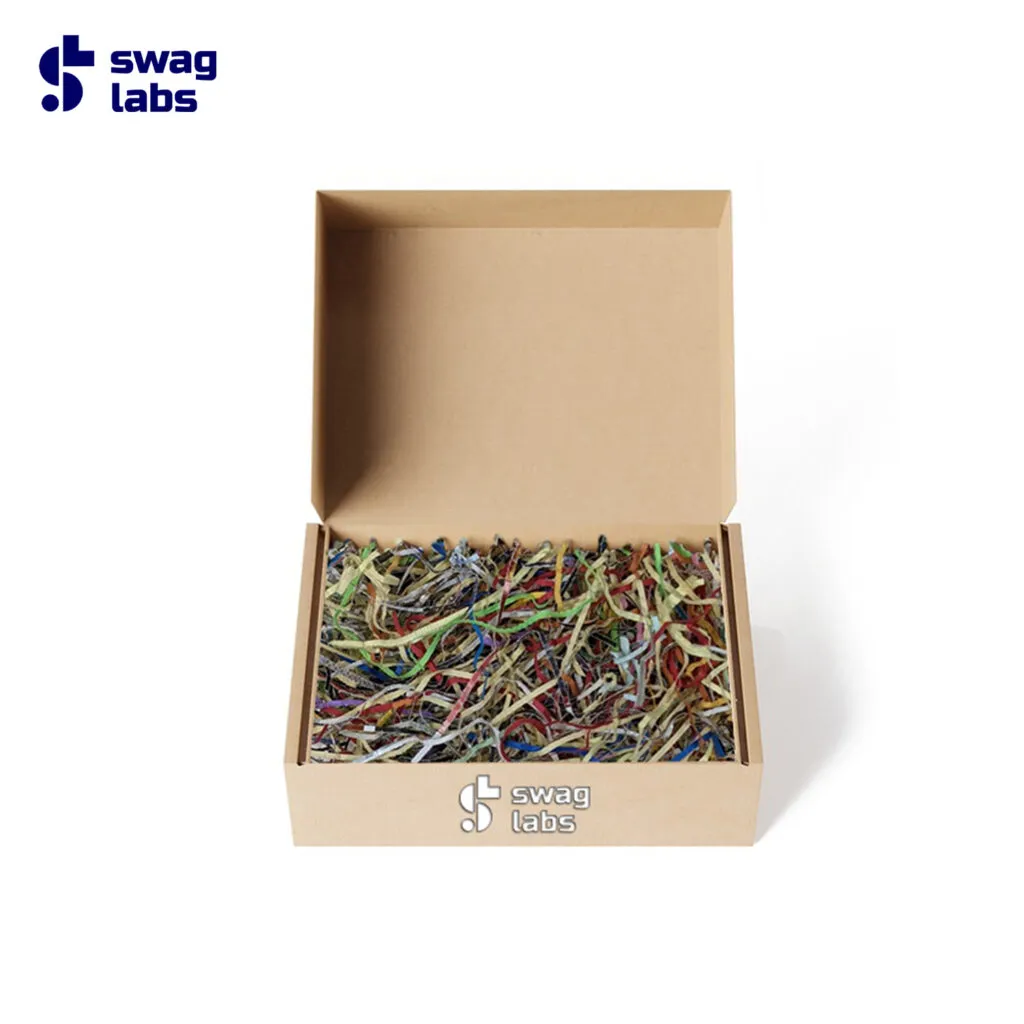
Frills Shreaded Multicolor Paper
Rs. 5/-

Pikmee Highline Tshirt
Rs. 649/-

Urban Gear Krono
Rs. 994/-

Rs. 295/-
